
Educational chess programmes for Dublin primary schools
One chess pathway, from Junior Infants to 6th Class
Three programmes, designed stage by stage, so a Junior Infants group and a 6th Class group get genuinely different sessions. Planned and taught by one person, with degrees in primary and early childhood education.
- Primary Education degree
- Early Childhood Education degree
- Children First trained
- Teaching chess since 2017
- Nobody is charged if a group does not fill
Running now
Autumn 2026
- Clubs are being taught in Dublin primary schools this term.
- Schools running a club this term are offered their January afternoon first.
No school and no child is named on this site.
The journey
One child, one piece, and then a whole school playing
Junior Infants meet a single knight on an empty board. By 6th Class the whole set is out, the games are real games, and the thinking has somewhere to go. Eight years, one path, planned as one thing rather than as eight separate clubs.
The three stages, side by side, are on the programmes page.
January 2027
Taking bookings for January 2027. To start in the week of 11 January, enquire by 20 November.
Garda Vetting goes through the school and takes four to six weeks, longer around Christmas, which is what sets the date. Schools already running a club this term are offered their January afternoon first, and the rest go in the order enquiries arrive. Enquiries received by 20 November are quoted at the current programme rates for January 2027, held for 14 days while the school confirms the details.
Prefer it in class time, paid by the school? How that works
See the path from enquiry to first session: how a January start works
Enquiries are quoted at the current January 2027 rate until Friday 20 November 2026.
January 2027 · taking bookings
Enquire to start in January
Closes Friday 20 November 2026
23:59 Irish time
Enquiring does not commit your school to book. Programme dates are agreed separately, and availability depends on timetable, location and group configuration.
The Little Explorers library
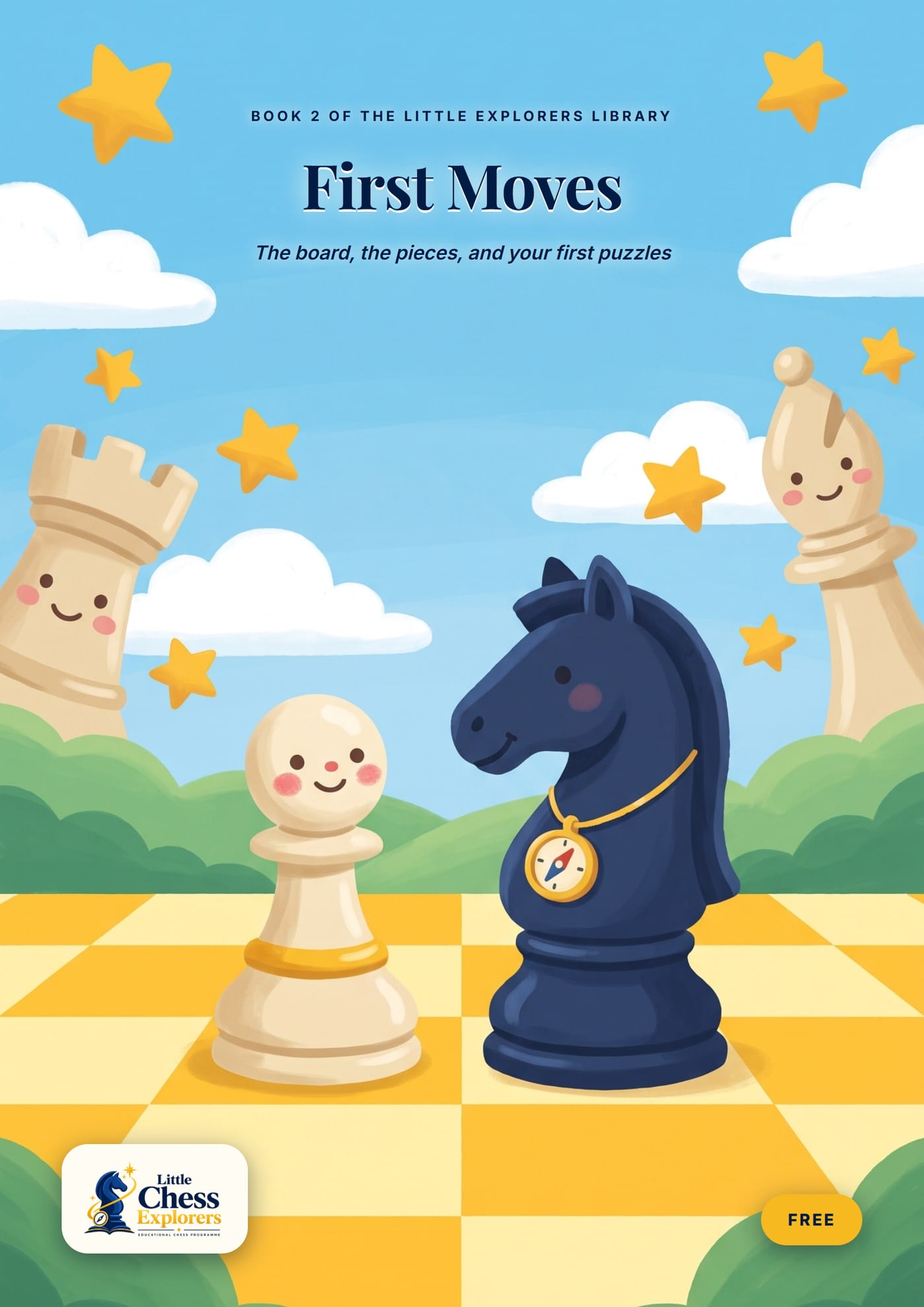
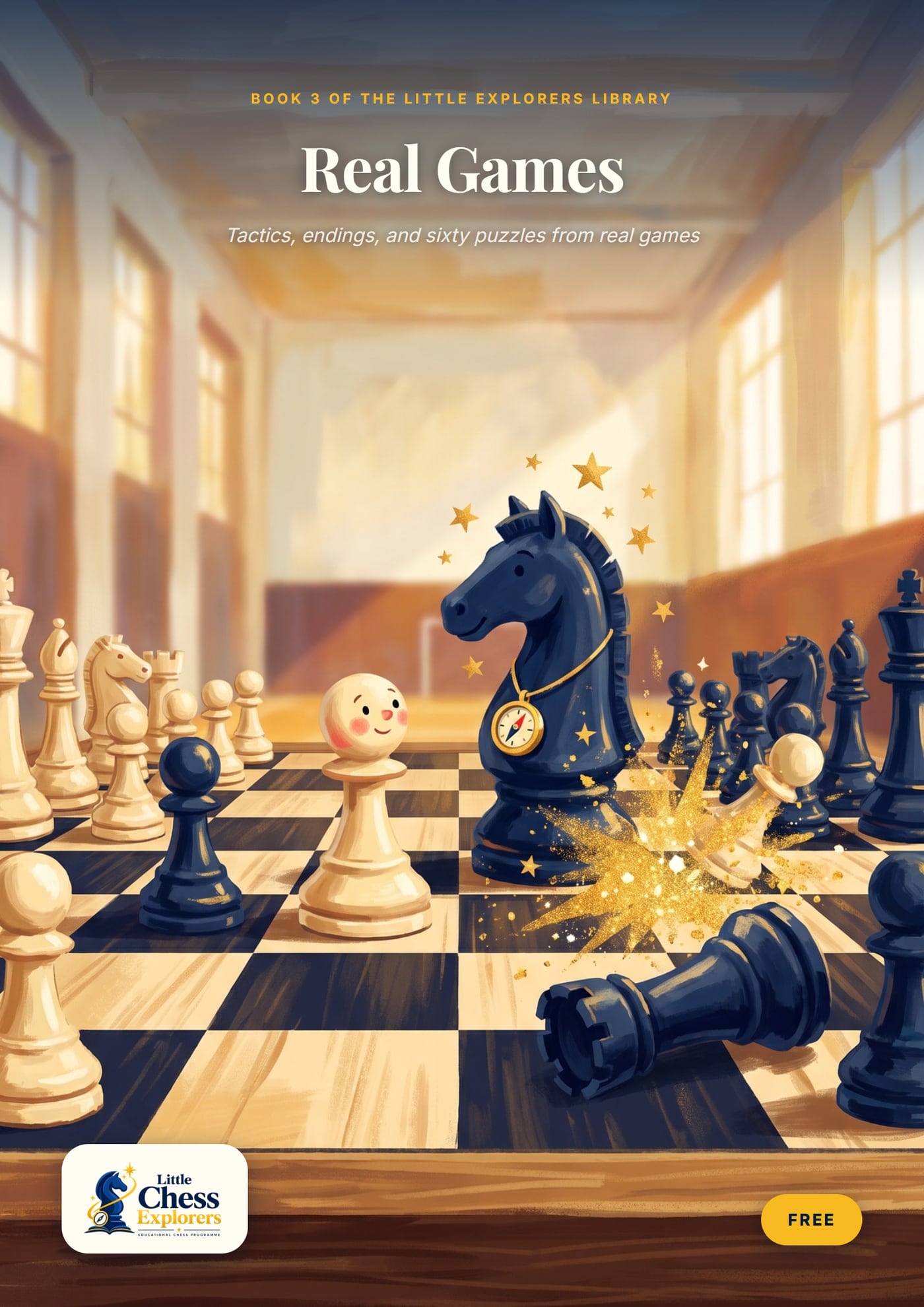
Three free books, for every family
Made so the chess a child meets in a session keeps going at home. Every move checked by computer. Free, for every family, no sign-up.
- A story set in Dublin
- A first puzzle book
- Sixty puzzles from real games
- Every move checked

One concept, three ages
Different stages need different chess, not the same lesson with easier words
It is the same piece in all three. Only the question changes, and the question is the programme. Pick a stage and try it.
The knight is going to jump. Tap every square it can land on.
0 found, 8 to go.
One piece, an empty board, and room to be wrong.
At this stage the whole lesson is the shape. No opponent, no capturing, no winning. A child who can see the eight squares has understood the knight, and that is a full session's work at five years old.
First Moves
Junior & Senior Infants · 45 minutes · 8 to 16 children
A first, happy meeting with the chessboard. Movement, stories and short games, not sitting still for forty-five minutes.
What a session looks like
- 1 Story
A short story sets up the piece of the day.
- 2 Move
Children move on a large floor board with their own bodies.
- 3 Discover
A guided question with one right answer to find.
- 4 Mini-game
A two to four piece game that finishes inside five minutes.
- 5 Celebrate
Each child shows one thing they worked out today.
What children are asked to do
- Recognising each piece by sight and by name
- Learning how one piece moves before meeting the next
- Taking turns and waiting for a turn
- Making a choice and saying why
- Finishing a short game without losing interest
Across a term, pupils work towards naming every piece, moving it correctly, and finishing a short game with a partner.
Full detail on all three programmesHow it works
Four steps, and only one of them is work for the school
- 01
Tell us which classes
One group or three. Most schools start with the age group where they already know there is interest.
- 02
Agree a day, a room and a start date
Sessions run straight after school, one group after another. A room with tables is all that is needed.
- 03
Families enrol and pay
Parent-funded is the standard option, so the programme does not come out of the school budget. A school-funded option exists for curricular blocks and workshops.
- 04
The programme starts
Teaching materials always come with the programme. For blocks of twelve weeks or more, the chess sets are included too: boards, pieces, transport and storage. A group that does not reach its minimum does not run, and nobody is charged.
Enrolment and parent communication can be handled for you, or you can keep it in whatever system your school already uses. Say which you prefer when you write to [email protected].
Who does what
Four things from the school. Everything else is ours
After-school activities usually fail on administration rather than on the activity. Here is the honest split.
The school provides
- A roomWith tables and chairs for the group size, straight after school.
- A time slotOne afternoon. Groups run back to back, so three groups is still one afternoon.
- A named contactOne person we can reach during the block. Usually the after-school organiser.
- AccessAgreed arrival, set-up and finish times, so nobody is waiting at a locked door.
Little Chess Explorers handles
- Programme planningWritten for the class group, not adapted on the day from a generic plan.
- The teachingEvery session, delivered in person.
- Lesson materialsIncluded in every programme, whatever its length.
- Equipment arrangementAgreed in writing before anything starts, from your own sets to a full service.
- Parent communicationHandled for you, or kept inside whatever system your school already uses. Your choice.
- EnrolmentRun by us or run by the school. Say which you prefer and it is set up that way.
Nothing above requires the school to buy anything, chase anybody, or take on a payment process it does not already run. The full practical detail is on the schools page.
Build your school's chess pathway
Put an afternoon together and send it over
Groups run one after another so no child sits in a session written for a different age. Choose what suits your school and it goes straight into the enquiry.
Monday, starting in January 2027
- 13:15Junior & Senior InfantsFirst Moves, 45 minutes, 8 to 16 children
- 14:151st & 2nd ClassPlaying the Game, 50 minutes, 8 to 16 children
- 15:153rd to 6th ClassThinking Ahead, 60 minutes, 10 to 18 children
Times shown are a typical after-school afternoon. Your school sets the real ones.
Put this into an enquiryBuilt on education, grounded in chess
The difference is who plans the lesson
Teaching chess well to a six year old asks for something different from teaching it well to an eleven year old. Holding a room of twenty Infants for forty five minutes, noticing the moment a child stops following, and changing the task on the spot are teaching skills before they are chess skills. Little Chess Explorers is built around that, because it is what a primary classroom runs on.
Primary Education degree
Bachelor's Degree in Primary Education with a specialisation in English.
Early Childhood Education degree
Bachelor's Degree in Early Childhood Education.
Garda Vetting
Completed in Ireland, most recently in 2026 through the Archdiocese of Dublin, Educate Together and Early Childhood Ireland. A disclosure is granted to a relevant organisation and does not transfer between organisations, so each school arranges its own, at no cost to it.
Children First training
Introduction to Children First, Tusla, October 2025.
Teaching chess since 2017
Educational and competitive chess taught in schools and clubs since 2017, from complete beginners through to competition preparation.
Master's in Bilingual Education
Master's Degree in Bilingual Education, awarded 2026.
The finding that shaped this approach
931 pupils. Chess only worked when the teaching did
A study of 931 primary pupils split them three ways: chess taught by instructors trained to teach problem-solving strategies, chess taught without that training, and no chess at all.
Only the first group improved at mathematical problem solving. The children taught chess without the teaching behind it did no better than the children who never touched a board. Separately, the largest school trial ever run found no effect on attainment. Its process evaluation, which is a different exercise from the trial itself, identified the tutors' teaching and class management as an area for improvement. That is an observation about how the sessions were run, not a demonstrated cause of the result.
Chess is not the active ingredient. The teaching is. That is the whole reason this programme is designed by somebody trained to teach children rather than by a strong player.
See what the research actually saysWhere this came from
Little Chess Explorers did not start as a business idea
The programme grew out of three university projects that all circled the same question: how should chess teaching change as children grow? How do you teach this game to a child of five, and then keep teaching it to the same child at eleven, without boring them or losing them along the way?
Teaching chess in schools and clubs since 2017, from children who had never seen a board through to children preparing for competition, kept pointing the same way: the chess is rarely the hard part. Getting the session right for the age in front of you is.
Little Chess Explorers starts from how pupils learn at each stage, and builds the chess experience around that stage. Not one class simplified for the youngest and stretched for the oldest, but three programmes written separately and designed to follow on from each other.
How that turned into a lesson planThree university projects, one question
Early Childhood Education
Chess in early childhood as a driver of learning
How a four to six year old meets a chessboard for the first time, and what has to be true of the session for that to go well.
Primary Education
Chess against the barriers to maths
Chess as an inclusive way into number and space for children who have already decided they are bad at maths.
Master's, bilingual education
Chess as a teaching resource in bilingual primary classrooms
Teaching a subject and a language at the same time, through a game with almost no text in it.
Titles are translated from the original Spanish. The bilingual education work is postgraduate level. No Irish NFQ level is claimed for any of them, because formal equivalence has not been assessed.
Start small
Try one short block before deciding anything bigger
Nobody should have to take a year of a new activity on trust. The normal way in is a single short block, reviewed honestly, and then a decision made with real information instead of a brochure.
- Now
One short block, after midterm
Six weeks, one group or three. Long enough for children to reach real games and short enough that nobody is committing the school year to something untested.
- December
Look at what actually happened
Attendance, what the children can do, what the families said, what worked in the room. A short written summary, not a sales meeting.
- January
Continue, change it, or stop
Continue into Term 2, add a second or third age group, change the day, or simply stop. There is no rolling contract and no notice period.
Taking bookings for January 2027. Afternoons go in the order enquiries arrive.
Chess in Irish primary schools
Chess is already well established in Irish primary schools
This is not a new idea being sold into schools from outside. Irish primary teachers built the movement themselves.
- Since 2017
- Ficheall has grown from a handful of schools into a national network of primary teachers running chess.
- SPHE-linked
- Ficheall developed a set of chess lessons aligned to the Social, Personal and Health Education curriculum.
- Féile Fichille
- Primary schools across the country send teams to Ficheall tournaments during the school year.
- Irish Chess Union
- The ICU runs junior championships and maintains a national network of junior-friendly clubs.
Ficheall is an independent network of Irish primary teachers. Little Chess Explorers is not affiliated with Ficheall or with the Irish Chess Union, and mentions them here only as context for schools deciding whether chess belongs in the timetable.
Try it in twenty seconds
Help the knight reach the star
Nobody is going to tell you the rule. Tap a dot, watch what happens, and work out the shape. That is a real week two task from the Junior and Senior Infants programme, and it is the whole method in miniature: one piece, one idea, nothing else on the board.
No sign-up, no download, nothing stored. The shortest possible route is worked out for you at the end so you can see how you did.
Tap a dot. A knight only moves in an L shape.
Explore chess
Things to try, whether or not your school books anything
Free, no sign-up, and nothing is stored about anyone who uses them.
Help the knight reach the star
Twenty seconds, no chess knowledge needed. It is the same puzzle Infants meet in week two.
OpenFind the move
Forty four real positions from real games, taken from the open Lichess database and checked one by one.
OpenPlay a full game
The complete board, with take back, board flip, sound, PGN in and out, and a keyboard you can play the whole game with.
OpenHow the pieces move
One rule each, in one line, and the squares each piece reaches from wherever you put it.
OpenWhat your brain is doing
A labelled diagram of a single move, and a straight answer about what it does and does not prove.
OpenChess through time
Where the game came from, and the one rule change around 1475 that mattered more than all the others.
Open
About this website
- Free to explore
- Every game, puzzle and quiz on this site is open. Nothing is behind a sign-up.
- No child sign-up
- No account, no name, no age, no email. A child can use everything here without giving anything.
- Nothing stored
- No analytics service, no advertising pixel, no third-party script. Nothing about your visit leaves your browser.
- Works with a keyboard
- A whole game of chess can be played with arrow keys and Enter, and every square says its name out loud.
What schools ask first
The three questions, answered before you have to ask them
- Who pays?
- Families, as standard. The programme does not come out of the school budget and the school is not asked to fund it. A school-funded option exists for curricular blocks and one-off workshops if that suits you better.
- What does the school have to provide?
- A room with tables, an agreed afternoon, and a named contact. Equipment is agreed in writing before anything starts, and lesson materials are always included.
- Can complete beginners join?
- Yes, and most do. Every programme is written for children who have never touched a chessboard. Parents do not need to know chess either. Children who already play get harder versions of the same task rather than a separate class.
Everything else, including vetting, safeguarding, group sizes and room requirements, is on the schools page. If you need something to forward internally, there is a briefing written for a Board of Management.
After you press send
What you are letting yourself in for, exactly
Enquiring about something usually means signing up for a fortnight of emails. Here is the whole thing.
- Same week
A written reply, not a phone call
An answer to what you asked, with the group sizes and dates that fit your afternoon. Nobody rings you out of the blue.
- With that reply
A quotation you can forward
One page, with the real figures for your school and what families would pay. Written so it can go to a Board of Management without being explained first.
- Only if you want it
Twenty minutes, in person or on a call
To look at the room and agree a day. Plenty of schools skip this and settle the whole thing by email, which is fine.
- If the answer is no
That is the end of it
No follow-up sequence, no newsletter, no second and third email. If it is not the right year for your school, say so and nothing else arrives.
Bring chess to your school
Tell us the class groups you have in mind and you will get a written answer with dates, group sizes and what it would cost your families. No obligation, and the whole thing can be handled in writing if that suits your week better.
Parents can ask for it too. There is a short form for that on the families page.